
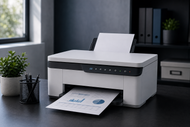
A: List monthly pages, colour use, media sizes, user count, and required scanning features. Match those facts to the printer’s recommended volume and paper support.
A cheap printer can become the most expensive machine in your office. The purchase price appears once, while ink, toner, drums, labels, paper, repairs, and staff time keep adding to the bill. Buying a printer in 2026 should start with workload and total cost of ownership, not a sale sticker.
Hybrid work has changed what buyers need. A home printer may receive jobs from phones, laptops, and cloud folders.
An office printer may serve several departments, scan contracts, protect private jobs with PIN codes, and report supply levels. Refillable ink tanks and high-yield toner can control running costs.
Printers are output devices that turn digital text, graphics, photos, barcodes, or records into marks on paper, labels, card, film, or other media. Different printers create those marks with liquid ink, dry toner, heat, ribbon transfer, or mechanical impact.
Modern printers can scan paper into searchable files, copy documents, route files to email or cloud storage, accept mobile jobs, and join business networks. Some hold print jobs until the user enters a PIN.
A printer may capture information, route files, protect records, and track supplies. The right choice depends on its daily role, not merely the pages it can print.
For more on parts, cartridges, and page yield, read our guide, “What Is a Printer & Cartridge? A Beginner’s Guide to Smarter Printing 2026.” It helps new buyers compare machines and supplies.
Start by measuring what you print. Check invoices, reports, schoolwork, labels, photos, forms, and copied pages across a normal month. A person printing fewer than 200 pages has different needs from an office producing 5,000 pages.
Record the media. Black text suits a monochrome laser printer. Photos and colour brochures point toward InkJet Printers or colour laser models.
Shipping labels need a Label Printer or Barcode Printer. Multipart invoices may need Dot Matrix Printers.
Count users. One person can work with USB. A shared office needs Ethernet or steady Wi-Fi, user controls, a larger tray, and longer-lasting supplies. Busy teams should seek automatic document feeders, duplex scanning, and extra trays.
List weekly features. Do not pay for faxing, finishing units, or wide-format output that will sit idle.
Choose the marking method first. Laser Printers suit sharp text and higher document volume. InkJet Printers suit photos, colour graphics, and mixed media. Thermal units handle labels and receipts. Impact machines handle continuous or multipart forms.
Calculate cost per page by dividing supply price by stated page yield. A $90 toner rated for 3,000 pages costs three cents per page before drums, maintenance kits, and waste containers. Heavy colour coverage can raise real costs.
Match speed to demand. Pages per minute measures sustained speed. First-page-out time measures the wait for a new job. Long warm-ups slow offices that print many short documents.
Check the recommended monthly volume, not just the maximum duty cycle. The duty cycle shows an upper limit for comparison. The recommended range gives a safer working level for regular use.
Confirm USB, Ethernet, dual-band Wi-Fi, AirPrint, Mopria, operating-system support, cloud apps, and required network security.
All-in-One Printers combine printing, scanning, copying, and sometimes faxing in one desktop unit. They suit homes and small offices with limited space, though one fault can interrupt several tasks.
Barcode Printers create 1D and 2D codes with direct thermal or thermal-transfer methods. Warehouses, shops, hospitals, and logistics teams use them for tracking. Direct thermal needs no ribbon; thermal transfer suits longer-lasting labels.
Dot Matrix Printers strike an inked ribbon with small pins. They work with tractor-fed paper, waybills, and carbonless forms. They offer low text costs but make noise and produce weak graphics.
InkJet Printers spray liquid ink through printhead nozzles. Cartridge models cost less upfront. Tank models hold more ink and can lower page costs. Inkjets produce smooth colour and detailed photos, but idle nozzles can clog.
A Label Printer feeds rolls or fanfold stock with close size control. E-commerce sellers use them for addresses, stock tags, and stickers. They avoid sheet waste, but each unit supports set widths and materials.
Laser Printers place an electrical image on a drum, attract toner, and fuse it to paper with heat. They produce crisp, smudge-resistant text and handle repeated office jobs. High-yield toner can reduce page costs.
Multifunction Printers, or MFPs, overlap with all-in-one models, but commonly cover larger business machines. They may include duplex scanning, extra trays, finishing tools, user accounts, and network controls for shared departments.
A home printer targets light work, short jobs, and one or two users. It may have a small tray, slower scanner, lighter rollers, and lower recommended volume. An Office Printer uses parts built for repeated feeding, larger supplies, shared access, and longer daily use.
Price can mislead buyers. A $60 Home Printer may require small cartridges with a high page cost. A $300 Business Printer with high-yield toner or refillable tanks may cost less after two years. Compare the machine, supplies, service parts, energy use, and time lost to refilling or clearing jams.
Security creates another divide. A shared Business Printer may need encrypted network traffic, user sign-in, PIN release, restricted address books, and storage controls.
Home users may only need password-protected Wi-Fi and firmware updates.
A small business or home-based executive can choose a compact monochrome laser for contracts and reports. A refillable colour ink tank makes more sense when colour appears in daily documents and print volume stays moderate.
A high-volume administrative team should consider a monochrome laser MFP with automatic two-sided scanning, more than one tray, high-yield toner, and a recommended volume above its measured monthly output.
Creative teams need accurate colour, suitable paper weights, and support for larger sheets. A wide-format inkjet works well for proofs, posters, and photo-heavy work. A colour laser suits fast presentations and business graphics where repeatable text quality matters more than photo detail.
Warehouses should separate tasks. Use a thermal Barcode Printer for tracking labels and a rugged dot matrix unit when staff still need multipart slips.
Resolution measures dots per inch. Text and standard office graphics can look sharp at 600 by 600 DPI. Fine photos and artwork can gain from higher inkjet resolution, though paper and ink quality also shape the result.
Compare PPM with first-page-out time. Short office jobs benefit from a quick first page. Long reports benefit more from sustained speed.
Read both monthly figures. The maximum duty cycle marks a ceiling. The recommended monthly volume gives the better buying target. Leave room for busy seasons rather than running at the top of the range.
Check tray size, bypass feeding, automatic duplex printing, supported paper weights, envelope handling, and output capacity. A fast printer still wastes time if someone must refill paper all day.
Review software support and security before purchase. Confirm current drivers, mobile printing, remote setup, access controls, firmware updates, and compatibility with the devices your staff use.
Look for replaceable rollers, drums, fusers, maintenance boxes, and extra trays. Available service parts can keep a printer working longer and reduce early replacement.
The best printer is the one sized for your real volume, media, speed, and user count. Measure the work, choose the print method, calculate page cost, check the recommended volume, and confirm network support before ordering.
Newtown Spares supplies printers, cartridges, label printers, printer accessories, rollers, fusers, paper trays, and maintenance kits across many brands and models. Buyers can source a machine and matching supplies or replacement parts from one place.
Check exact model numbers before ordering, since similar printer names may use different cartridges and service parts.
A: List monthly pages, colour use, media sizes, user count, and required scanning features. Match those facts to the printer’s recommended volume and paper support.
A: High-yield laser and refillable ink-tank models can offer low page costs. The better choice depends on colour coverage, volume, and supply prices.
A: No. Standard text does not need photo-level resolution. Higher settings can slow printing and use more ink without improving normal office pages.
A: Yes. Allow room for added users, busier months, new paper sizes, and higher scanning demand without buying far beyond realistic growth.
A: It helps compare machine strength, but the recommended monthly volume matters more for regular workload planning.
A: Newtown Spares can help buyers find printers, compatible supplies, accessories, and service parts by brand, model, workload, and printing type.

Posted Sep 07, 2023

Posted Sep 07, 2023

Posted Sep 06, 2023
Posted Sep 05, 2023
Posted Sep 01, 2023

Posted Aug 30, 2023

Posted Aug 30, 2023