
A: Both connect multiple devices into one wired network. A hub repeats incoming signals to all ports at Layer 1. A switch reads MAC addresses at Layer 2 and sends each frame only where it belongs.
Every wired network needs something in the middle that ties the cables together. That job belongs to hubs and switches.
Plug a few computers, printers, cameras, or access points into one box, and suddenly they can talk to each other without touching the internet at all.
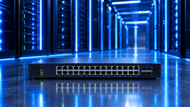
The two devices look almost identical from the outside. Same metal case, same rows of RJ45 ports, same blinking lights. What happens inside is where they split apart, and that difference decides whether your network crawls or flies.
A network hub is a repeater with several ports. It works at Layer 1 of the OSI model, the physical layer, so it reads nothing about the data passing through. When a frame arrives on port 3, the hub copies that electrical signal out of every other port.
Every device connected to it receives every transmission and has to decide for itself whether the frame was meant for it. A hub has no memory, no address table, and no decision-making of any kind.
A network switch works one layer up, at Layer 2, the data link layer. It reads the MAC address inside each frame and builds a table that maps every address to the port where it was seen. Once that table fills in, the switch stops copying traffic everywhere.
A frame for a specific device leaves through one port only. Each port also runs in full duplex, so a device can send and receive at the same time without collisions.
Without one of these devices, a wired network is just point-to-point links. You could join two PCs with a crossover cable and stop there.
Hubs and switches let dozens or hundreds of endpoints share one local network, keep local traffic local instead of pushing it through a router, and give you a single place to run cabling back to. Almost every wall socket in an office traces back to a switch port somewhere.
Through the early 1990s, 10BASE-T hubs replaced the coaxial bus cabling that Ethernet started with. They were cheap and easy. They also kept one weakness from that older design: every port sat inside the same collision domain.
Devices used CSMA/CD, which means they listened to the wire, sent when it sounded quiet, and backed off when two transmissions overlapped. A 10 Mbps hub with twelve busy machines gave each one a small slice of that 10 Mbps.
Switching gear arrived commercially around 1990 and dropped in price fast through the mid to late 90s. The pitch was simple. Each switch port became its own collision domain, so collisions stopped happening.
Full duplex support in IEEE 802.3x then doubled usable throughput per link. By the time Fast Ethernet and Gigabit Ethernet became normal, hubs could not keep up mechanically or economically.
Switches won because shared bandwidth stopped being acceptable. A modern Ethernet switch gives every port its own path, tracks addresses in hardware using ASICs, and forwards at wire speed. Hubs are no longer manufactured for mainstream use.
You will find them in old equipment cupboards, industrial installs that nobody has touched in years, and networking courses that teach collision behaviour.
An Ethernet hub amplifies and repeats. A signal comes in, gets cleaned up, and goes back out everywhere else. Because all ports share one channel, only one device can transmit cleanly at a time.
Two at once produces a collision, both back off for a random interval, and both try again. Traffic rises, collisions rise, and usable throughput drops well below the rated speed. Everything also stays half duplex.
A switch does four things with every frame: learn, flood, forward, filter. It learns the source MAC and records the port. If the destination address isn't in its table yet, it floods the frame out of all other ports once.
When the reply comes back, that address gets learned too, and future frames go straight to the right port. Store-and-forward switching buffers the whole frame and runs a CRC check before sending.
Cut-through forwarding reads only the first few bytes and starts pushing the frame out immediately, which cuts latency for trading floors and storage networks.
Inside a LAN, two devices on the same switch talk to each other directly through the switching fabric. The router never sees that traffic.
Broadcasts, like ARP requests, still reach every port because a switch is one broadcast domain by default. VLANs, defined in IEEE 802.1Q, split that single switch into separate logical networks so the sales VLAN and the CCTV VLAN don't hear each other's broadcasts.
If you're mapping out a full setup and comparing routers, access points, media converters, and switching gear side by side, our Buying Guide of Networking Devices 2026: What You Need To Know walks through how these parts fit together and what to check before you order. This article stays focused on hubs and switches, so use that guide for the wider picture.
Both devices do the same basic job of turning one network into many ports. Port counts run from 5 and 8 on desk-side units up to 24 and 48 in rack-mount models, with SFP or SFP+ cages for fibre uplinks.
Power over Ethernet models carry data and power down the same cable, which is how most IP cameras, door readers and wireless access points get installed now.
Here the two part ways. A hub can't manage anything. A switch can. Managed models handle VLAN tagging, quality of service queues for voice and video, port mirroring, link aggregation under 802.3ad, and Spanning Tree Protocol to kill loops before they take down the network with a broadcast storm.
Switches check frame integrity, drop corrupted frames, buffer bursts, and honour flow control. Hubs pass on whatever arrives, including noise.
On a busy segment, that means retransmissions at higher layers and applications that feel sluggish for no obvious reason.
Passive hubs just join wiring and split the signal with no power and no amplification. Active hubs regenerate weak signals, which lets you run longer cable segments, and they need a power supply.
Intelligent or manageable hubs added basic monitoring and remote diagnostics, mostly on stackable chassis units. All three sit at Layer 1, and all three share bandwidth across every port.
Unmanaged switches work the moment you plug them in, with no configuration at all. Smart or web-managed switches add a browser interface for VLANs, port settings and simple monitoring at a modest price.
Fully managed switches bring CLI access, SNMP, stacking and deep control for data centre and campus use. Layer 3 switches route between VLANs in hardware. PoE, PoE+ and PoE++ models supply 15.4W, 30W and up to 90W per port.
Speeds now run from Gigabit through 2.5G and 5G multigig for Wi-Fi 6E and Wi-Fi 7 access points, up to 10G, 25G, 40G, and 100G in the core.
Every switch port gets dedicated bandwidth in both directions. 24 gigabit ports in full duplex can push far more aggregate traffic than any shared medium ever could, and a non-blocking switch has enough internal capacity to run every port at full speed at once.
Micro-segmentation means each port is its own collision domain, so collisions vanish. Filtering keeps unicast traffic off ports that don't need it. VLANs shrink broadcast domains. Busy links stop poisoning quiet ones.
Lower latency, fewer dropped frames, fewer retries. Quality of service queues push voice and video ahead of bulk file transfers, so a big backup job doesn't wreck a video call happening at the same time.
Training labs use hubs to demonstrate collisions and to capture all traffic on a segment with a packet analyser. Some very old industrial or lab instruments are wired to hubs and still work. That's about the extent of it.
Everywhere else. Offices, homes, warehouses, camera systems, VoIP deployments, server rooms. If the network carries anything time-sensitive or more than a trickle of data, a switch is the answer.
Count your devices, add room to grow, then decide on speed per port, uplink type, PoE budget in watts, and whether you need VLANs or remote management. A small flat network runs fine unmanaged. Anything segmented, monitored or growing wants a managed model.
Shared bandwidth, half-duplex operation, no security boundary, and no way to see what's happening. A packet sniffer on a hub reads everyone's traffic, which is a serious exposure on its own.
Managed switches need care. Mismatched VLAN tags, wrong spanning tree settings, loops from a mis-patched cable, duplex mismatches, and default admin passwords all cause real outages. Keep a port map and a config backup.
Buying exactly the number of ports you need today is a mistake you pay for twice. Leave headroom, check the PoE power budget against future camera and access point loads, and match uplink speed to where traffic actually goes.
Cloud-managed switching keeps spreading, letting one dashboard handle sites in different cities. Multigig ports are becoming standard access-layer gear as Wi-Fi 7 pushes past gigabit, and PoE++ is carrying more device types than ever.
SDN separates the control logic from the forwarding hardware. Switches take instructions from a central controller instead of running everything locally, which makes large fabrics faster to change and easier to automate.
Expect more automation through intent-based configuration, wider adoption of 25G and 100G in the core, tighter access control at the port level with 802.1X, and better telemetry so problems surface before users report them.
Hubs repeat. Switches decide. That one sentence explains the entire gap between them. Hubs earned their place in networking history and then got left behind by full-duplex operation, dedicated per-port bandwidth, and hardware forwarding.
If you're building or repairing a wired network in 2026, a switch is the device you want, and the only real questions left are port count, speed, PoE budget, and how much control you need over traffic.
A: Both connect multiple devices into one wired network. A hub repeats incoming signals to all ports at Layer 1. A switch reads MAC addresses at Layer 2 and sends each frame only where it belongs.
A: They give devices a shared meeting point. Traffic between two machines on the same unit stays local instead of going through a router, which keeps local file transfers, printing, and VoIP calls fast.
A: Dedicated bandwidth per port, full duplex operation, no collisions, frame error checking, VLAN support, and management features. Hubs offer none of that and are no longer made for general use.
A: By expanding one network connection into many ports and handling device-to-device traffic internally. With a switch, you also get traffic separation, loop protection, and power delivery over the same cable.
A: Yes, they'll interoperate electrically. The hub still shares bandwidth and stays half-duplex, so that segment becomes the slow spot. Replacing it with a small switch costs very little and removes the bottleneck.
A: They learn source MAC addresses, flood frames with unknown destinations once, forward known traffic to a single port, and filter it from the rest. Store and forward checks the whole frame first, while cut-through starts sending sooner for lower latency.
A: Port count with room to grow, speed per port, uplink type such as SFP or SFP+, total PoE wattage, managed versus unmanaged, switching capacity, and whether the unit needs to be rack-mounted, fanless, or DIN rail-mounted.

Posted Sep 07, 2023

Posted Sep 07, 2023

Posted Sep 06, 2023
Posted Sep 05, 2023
Posted Sep 01, 2023

Posted Aug 30, 2023

Posted Aug 30, 2023